Written and reviewed by Rice Design Alliance Editorial Team.
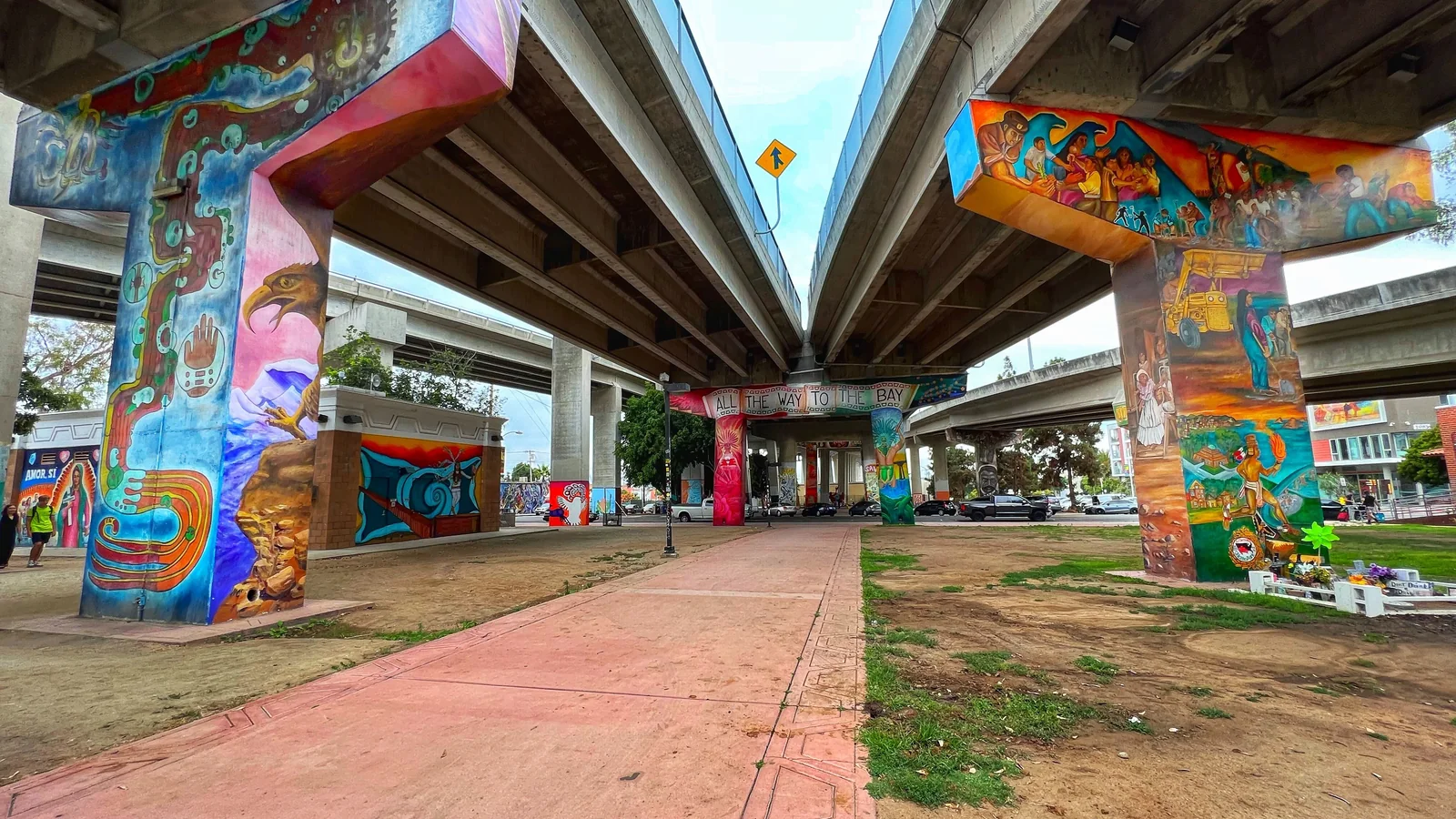
Stand beneath the freeway columns of San Diego’s Chicano Park and you’re surrounded by monumental murals painted on the very infrastructure that once threatened to erase a neighborhood—a park residents reclaimed and defended until it earned National Historic Landmark status in 2016. That tension runs through the whole subject of this guide: American social movements didn’t just happen in cities; they fought over what cities are, who gets to occupy them, and who controls their housing, schools, transit, and public space. Social movement historical sites preserve those struggles in brick, asphalt, and memory. This article reads them through two lenses at once: the historical record of organizing and protest, and the practical realities of visiting—because a landmark designation and an open front door are two very different things.
What Defines Social Movement Landscapes and Urban Rights?
Social movement historical sites encompass original protest locations, organizing headquarters, labor halls, churches, schools, neighborhoods, corridors, memorials, and even demolished addresses where communities fought for equal rights, labor power, and control over urban space, housing, transit, education, and public accommodations across the United States.
That definition is deliberately broad. A protest site is where something happened—a march, a sit-in, a strike. A heritage site is where meaning is preserved and interpreted, which may be the same place, a later memorial, or an empty lot with a marker. The NPS Civil Rights Framework organizes this history around public accommodations, education, housing, employment, and voting; we use “urban rights” as an editorial umbrella extending that list to transportation, public space, and community control.
You may also encounter the phrase “the right to the city.” In urban-studies scholarship, this phrase doesn’t refer to a single federal statute—it’s a contested theoretical and activist framework concerning both access to urban resources and collective power to reshape how cities are made, as urban-studies scholarship on social movements describes it.
Designations add another layer of confusion. Here’s how the major categories differ:
| Designation | What it signifies | What it does not guarantee |
|---|---|---|
| National Register of Historic Places (NRHP) listing | Official federal list of properties worthy of preservation; significance may be local, state, or national | Federal ownership, funding, or any public access |
| National Historic Landmark (NHL) | National significance designated by the Secretary of the Interior; every NHL is also NR-listed | Public interior access—many NHLs are private |
| National Park System unit (National Historic Site, Historical Park, Monument) | A federally administered park unit established by Congress or presidential proclamation | That every building on the grounds is open; hours and tours vary |
| African American Civil Rights Network (AACRN) | An NPS-recognized collection of properties, facilities, and programs tied to African American civil rights history | New application intake or logo approvals—Congress has not reauthorized the program since it expired January 8, 2025, so it isn’t accepting applications or logo-usage requests |
As the NPS National Historic Landmarks FAQ makes clear, none of these labels automatically means federal ownership. Treat them as significance markers, not visitor passes.
Southern Civil Rights Corridors, Strategy Hubs, and School Grounds
The Southern civil rights heritage sites most travelers know—Selma, Birmingham, Little Rock—reward a wider reading. These weren’t isolated pins on a map. They were corridors, headquarters, and contested institutions, woven together by local coalitions whose pressure connected to federal enforcement and, eventually, to the Civil Rights Act signed July 2, 1964, and the Voting Rights Act signed August 6, 1965 (the National Archives preserves both enrolled acts and the voting statute’s provisions). No single march produced those laws; campaigns, litigation, and organizing did, over years.
The 54-Mile Selma-to-Montgomery Corridor and Birmingham’s Project C Hub
The Selma-to-Montgomery National Historic Trail follows U.S. Highway 80 for 54 miles through Lowndes County, running from Brown Chapel A.M.E. Church in Selma to the Alabama State Capitol to commemorate the 1965 Voting Rights March that began with Bloody Sunday on March 7, 1965. It’s a corridor, not a landmark—road conditions and partner-site hours vary along the route, per the NPS Selma-to-Montgomery FAQ. Contrast that scale with one building: Birmingham’s A.G. Gaston Motel served as the 1963 Project C movement headquarters, hosting strategy sessions and press conferences. Note that the motel’s 1954 wing temporarily closed in May 2026 for renovations to exhibits, offices, elevator access, and the master suite/war room.
Segregated School Geographies in Topeka and Little Rock
Schools were battlegrounds of everyday geography. Brown v. Board of Education National Historical Park preserves Monroe Elementary in Topeka, the school Linda Brown attended after being denied admission to all-white Sumner Elementary. In Little Rock, the Little Rock Nine began their first full day at Central High School on September 25, 1957, escorted by the 101st Airborne. Located at 1500 Little Rock Nine Way and managed by the Little Rock School District, the National Historic Landmark school building remains an active high school closed to the general public; visitors use the National Historic Site’s grounds and programs instead.
Company Towns, Union Halls, and Working-Class Urban Spaces
Labor history is urban history. Nowhere is that clearer than Chicago’s Pullman neighborhood, where George Pullman’s planned company town made architecture an instrument of control—wages, rents, and daily life administered by one employer. When the company cut wages without cutting rents, workers walked out on May 11, 1894, and the American Railway Union’s boycott of Pullman cars disrupted rail traffic nationwide. Pullman National Historical Park interprets the whole historic district—the town’s planning, the strike, and the Brotherhood of Sleeping Car Porters, whose Black porters later built one of the era’s most important labor and civil rights organizations. The strike of 1894 shows how a neighborhood dispute became a national transportation conflict.
Chicago also offers a lesson in distinguishing event sites from memorials. The Haymarket Martyrs’ Monument in Forest Home Cemetery in Forest Park, Illinois—dedicated June 23, 1893 by the Pioneer Aid and Support Association, managed by the cemetery, and listed as both an NRHP property and an NHL—is a commemorative gravesite, not the original 1886 protest square. And at 901 Massachusetts Ave NW in Washington, D.C., the American Federation of Labor Building served as the AFL’s national headquarters from 1916 to 1955, demonstrating that unions built permanent political infrastructure alongside picket lines. Designated an NHL in 1974, the building is now integrated into a later hotel complex with limited interior access.
Northern and Urban Justice Landmarks: Redevelopment, Stonewall, and Seneca Falls
A South-only itinerary misses half the story of urban social justice history. Northern cities staged their own fights over displacement, policing, and public space. In New York’s Lincoln Square, residents resisted urban renewal demolition with protests including a 1956 “Shelter Before Culture” demonstration, documented in the New York Heritage urban renewal exhibit, illustrating how mid-century redevelopment projects triggered organized neighborhood resistance.
On June 28, 1969, a police raid on the Stonewall Inn provoked resistance and nights of demonstrations in Christopher Park and the surrounding streets. The NPS history of Stonewall National Monument frames the uprising carefully: a milestone that gave momentum to longer LGBTQ+ organizing, not its beginning. Women’s rights history anchors farther upstate at the Wesleyan Methodist Chapel in Seneca Falls, where the first Women’s Rights Convention met July 19–20, 1848 and presented the Declaration of Sentiments.
The newest addition is Harlem’s Urban Civil Rights Museum, announced to open November 14, 2026, at 117 West 125th Street—billed as New York’s first museum dedicated to civil rights and one of the first focused on Northern history. Located on the fourth floor of 117 West 125th Street, its visitor information lists regular hours of Wednesday–Saturday 10:00 a.m.–5:00 p.m. and Sunday 12:00 p.m.–5:00 p.m. (closed Monday–Tuesday), with admission set at $20 for adults, $15 for seniors, youth (13–24), military, and visitors with disabilities, and free entry for children 12 and under and accompanying caretakers.
Western Landscapes of Community Control, Farmworkers, and Civil Liberties
In the West, movement history runs through infrastructure and land. Chicano Park’s NHL nomination records a December 23, 2016 designation and a 1970–1989 period of significance: residents reclaimed land beneath freeway infrastructure and transformed its columns into a cultural landscape of community murals. This is preservation driven by the community itself, not bestowed from above.
Farmworker organizing left its own geography. The NPS labor history program documents a 300-mile march to Sacramento by striking California farmworkers in 1966, and César Chávez’s Nuestra Señora Reina de la Paz (“La Paz”) compound in the Tehachapi Mountains at Keene, Kern County, became United Farm Workers headquarters in 1972—established as César E. Chávez National Monument on October 8, 2012, and designated an NHL the same day (distinct from the earlier Forty Acres site in Delano).
Manzanar National Historic Site layers displacement histories. Established by Congress on March 3, 1992, it was the first camp built to confine Japanese Americans during World War II—and the valley also holds Paiute and Shoshone history, farming, and Los Angeles water infrastructure. Civil liberties, Indigenous dispossession, and resource politics occupy the same ground.
Built Environment Politics: Disability Rights and Demolished Movement Sites
Accessibility itself has been a protest target. The NPS disability rights history identifies the 1988 Deaf President Now protest at Gallaudet University—where students demanded deaf leadership of the world’s premier university for deaf students—and the 1990 Capitol Crawl, when demonstrators left wheelchairs to climb the U.S. Capitol steps, making inaccessible architecture the direct object of direct action. These historic activist landmarks turn stairs, entrances, and governance offices into evidence.
Other movement memory sites survive only as absence. Malcolm X’s childhood home was demolished; Berkeley’s Cowell Memorial Hospital, tied to early independent-living history, is gone too. Researchers and travelers interpret such places through markers, surviving streetscapes, photographs, and archival addresses—the We Shall Overcome itinerary, created in 1998, includes private residences and altered sites for exactly this reason. A vanished building can still anchor a truthful visit if you know what you’re looking at—and what you’re not.
How to Verify Designations and Plan an Ethical Heritage Visit
Good heritage route planning starts with primary records, then moves to interpretation. Work through this sequence:
- Check the federal registry. Search the NPS National Register database (dataset last updated June 4, 2026) for listing dates, NHL designations, significance levels, and nomination documents.
- Read the nomination. NHL and NRHP nominations are the strongest sources for a site’s period of significance and integrity.
- Contact the SHPO or THPO. State and Tribal Historic Preservation Offices hold surveys and local records the federal database may miss.
- Then consult secondary maps. The Mapping American Social Movements Project adds organizational and geographic context—but treat it as a starting point, not an authority.
Before visiting, date-stamp your information: confirm hours and renovation closures (the Gaston Motel wing closure shows why), respect private residences and active schools like Little Rock Central High, check physical and sensory accessibility in advance, and practice quiet, restrained etiquette at sites of racial violence and confinement—minimal photography, no reenactment, and attention to descendant communities.
Conclusion: Reading the American City Through Movement History
Movement places remain vital because they’re evidence in an unfinished argument about who shapes the American city. Three takeaways to carry with you: first, significance and access are different things—designation doesn’t open doors. Second, read sites spatially, as corridors, company towns, reclaimed underpasses, and contested school grounds, not isolated pins. Third, include absence in your itinerary; demolished sites and markers are part of the record too. Your next step: pick one regional cluster—Southern corridors, Northern urban justice sites, or Western community-control landscapes—and build a weekend route using the National Register database and the current custodian pages above. Verify before you go, and the city will read differently afterward.